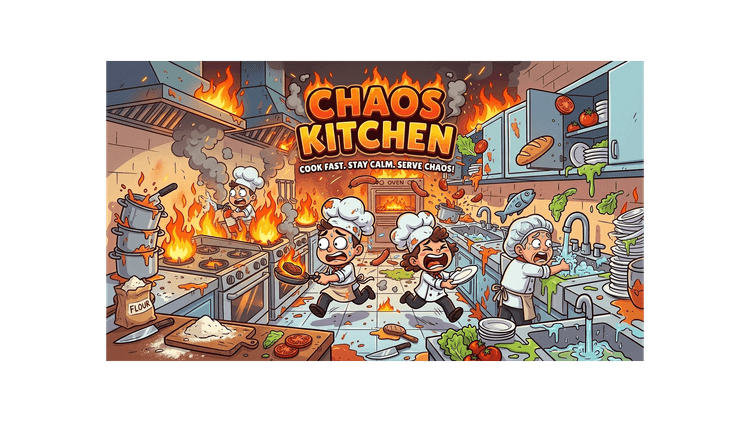
Chaos Kitchen
A browser game that ships as a single HTML file. You keep a kitchen running under pressure while the kitchen itself keeps trying to fall apart — hence the name.
How it plays
Orders are listed across the top of the screen. You grab ingredients from the crates, cook them at the right station, chop them where needed, plate them up, and carry the plate to the green SERVE counter. Filling the right order earns points and a combo; an order that times out breaks the combo.
Cooking is where the skill lives. Every dish starts undercooked, passes through an ideal window, then burns. Pull it inside the window and you get PERFECT; leave it too long and it's BURNT. Leave burnt food on a station and it catches fire, and the fire can spread to the neighbouring station — at which point you grab the 🧯 and hold ACTION to spray it out.
The chaos system
Events fire at random intervals to wreck your kitchen: grease fires, an exploding delivery crate, a lost knife, an angry customer, a gust of wind sweeping the room. The rules keep it fair — the same event never repeats back to back, a new one never stacks on top of an active one, and items are never destroyed. They get launched, they land on the floor, you can pick them back up. Annoying, but never cheap.
The last 15 seconds are FINAL RUSH: orders speed up, the pace lifts, the music accelerates.
Content
4 kitchens (Burger House to start), each with its own recipe set and difficulty curve
Level and XP system — new recipes and chef outfits unlock as you level
Coins and cosmetics — spend earnings on kitchens and looks
Daily challenge — a target that changes by date, with a bonus on completion
10 languages — menu chrome is translated, in-round text stays English
Modes
Single player, 2–4 player local co-op on one device, and online co-op (beta). Online runs host-authoritative: one device runs the real simulation and broadcasts state about 20 times a second, while the others ship their input and draw the freshest frame they've received. That's how the single-player code became multiplayer without being touched.
Controls
Keyboard: WASD to move, E to interact (hold to chop or spray), Space to drop, Shift to dash
Gamepad: left stick plus A/B/X, with support for second and third controllers
Touch: joystick on the left half, three buttons on the right — shown only on touch devices
Under the hood
Everything runs from one index.html. Rendering is canvas-based, with emoji sprites cached once because drawing emoji every frame is slow on mobile. Particles use fixed-size pools so there's no garbage-collector stutter. All audio is generated procedurally in WebAudio — not a single sound file to download, just a small synth recipe per event. Progress saves to localStorage. Localisation is a hand-rolled dictionary rather than a framework, and there's no game engine at all.
CrazyGames publishing requirements are handled too: room registration, invite links, invitees skipping the menu, and instant multiplayer.
0 Comments
Please sign in to leave a comment
No comments yet